Restore · Cellular Restoration Complex
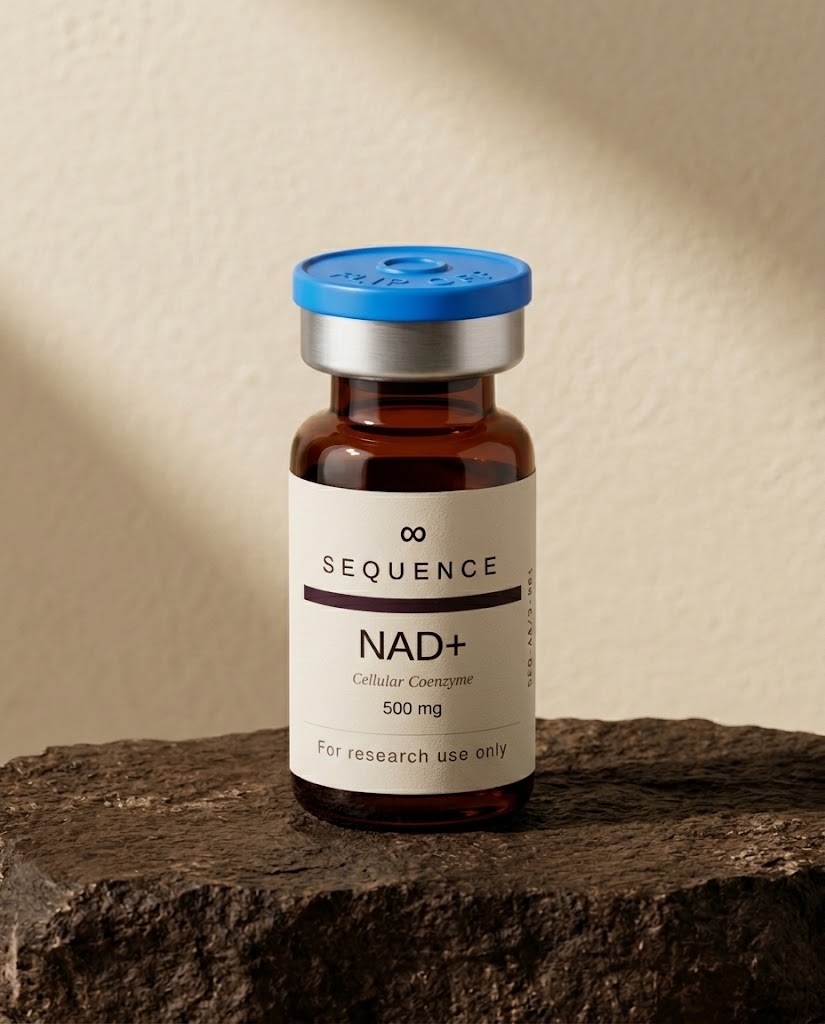
NAD+
A central cellular cofactor — supports mitochondrial energy, sirtuin activation, and DNA repair.
79,00 €
500 mg vial
In stock
Per reference18units
Cadence3× per week
Dose30mg
Vial500mg / 3 mL
About
A nicotinamide adenine dinucleotide coenzyme - central to redox reactions, ATP production, and sirtuin activation.
Research describes NAD+ as supporting cellular energy, detoxification, DNA repair, and longevity-related gene expression. Natural levels decline with age; restoration has been linked to mitochondrial function and cognitive clarity.
Sequence lists NAD+ under the Restore category - longevity, cellular energy.
Vial content
500 mg NAD+ in an amber vial at 166.7 mg/mL after reconstitution with BAC water.
At reference, 18 units on a U-50 insulin syringe draws approximately 30 mg. Inject slowly — NAD+ flushing is reduced by slower rate of administration. Rotate between abdominal quadrants, outer thighs, and upper arms.
Storage: refrigerated 2–8°C. Do not freeze. Protect from light.
Reported effectsWhat the literature
What the literature
describes.
Mitochondrial & metabolic health
Detoxification & cellular repair
Inflammation & oxidative stress
Longevity & healthy aging
Reported timelineWhat the literature
What the literature
reports, by phase.
Week 1–2
01
Week 1–2 — Increased energy and cognitive sharpness. Reported reduction in post-lunch fatigue.
Week 3–6
02
Week 3–6 — Steadier mood, clearer focus, mild improvements in exercise recovery.
Week 6–12
03
Week 6–12 — Consolidation of energy baseline. Reported improvements in sleep quality and morning clarity.
Long-term
04
Long-term — Sustained cellular energy profile after cycling. Research links to longevity-related gene expression.
Reference dosing
Reference profile.
Baseline
Standard18units / injection
30 mg · 3× per week
- Injection siteSubcutaneous · abdomen, thigh, upper arm
- RotationQuadrant cycle, avoid repeat sites
- TimingMorning - supports daytime energy production
Baseline
Agressive30units / injection
50 mg · 3× per week
- Injection siteSubcutaneous · abdomen, thigh, upper arm
- RotationQuadrant cycle, avoid repeat sites
- TimingMorning - supports daytime energy production
Recommended cycle
Three months on. One month off. Up to three cycles annually.
Cycling supports endogenous NAD+ salvage pathways. Inject slowly — rapid administration is associated with transient flushing and nausea.
Vial details
| Content | NAD+ (disodium salt) |
| Mass | 500 mg |
| Reconstitution | 3 mL water |
| Concentration | 166.7 mg/mL |
| Supply (baseline) | ~5 weeks |
| Storage | 36–46°F · 2–8°C · do not freeze · shield from light |
Mechanism
Cofactor. Sirtuins. Repair.
NAD+ functions as a cofactor in redox reactions and ATP production while activating sirtuins — longevity and repair pathways that depend on its availability. The molecule supports mitochondrial energy generation, cellular detoxification, and DNA repair.
At the system level, NAD+ modulates neurogenesis, immune balance, and cognitive performance through cellular repair pathways.
- CofactorRedox reactions across mitochondrial and cytosolic ATP production.
- SirtuinsActivates SIRT1–7 — longevity and repair pathway modulation.
- PARPsDNA repair enzymes depend on NAD+ for function.
- MitochondriaSupports oxidative phosphorylation and biogenesis.
Safety signalsReported side effects
Reported side effects
& contraindications.
Reported side effects
- Injection-site redness or mild discomfort
- Temporary stinging or itchiness at the injection site
- Flushing or warmth — especially with rapid injection
- Mild nausea or fatigue when administered quickly
Contraindications
- Active malignancy
- Pregnancy or breastfeeding
- Known peptide or excipient hypersensitivity
Severe swelling, fever above 38°C, worsening fatigue, rash, dizziness, hives, breathing difficulty, or facial swelling - discontinue and contact a clinician.
Watch it done properly.
Reconstitution, site rotation, storage — on video.