Regenerate · Skin Regeneration Complex
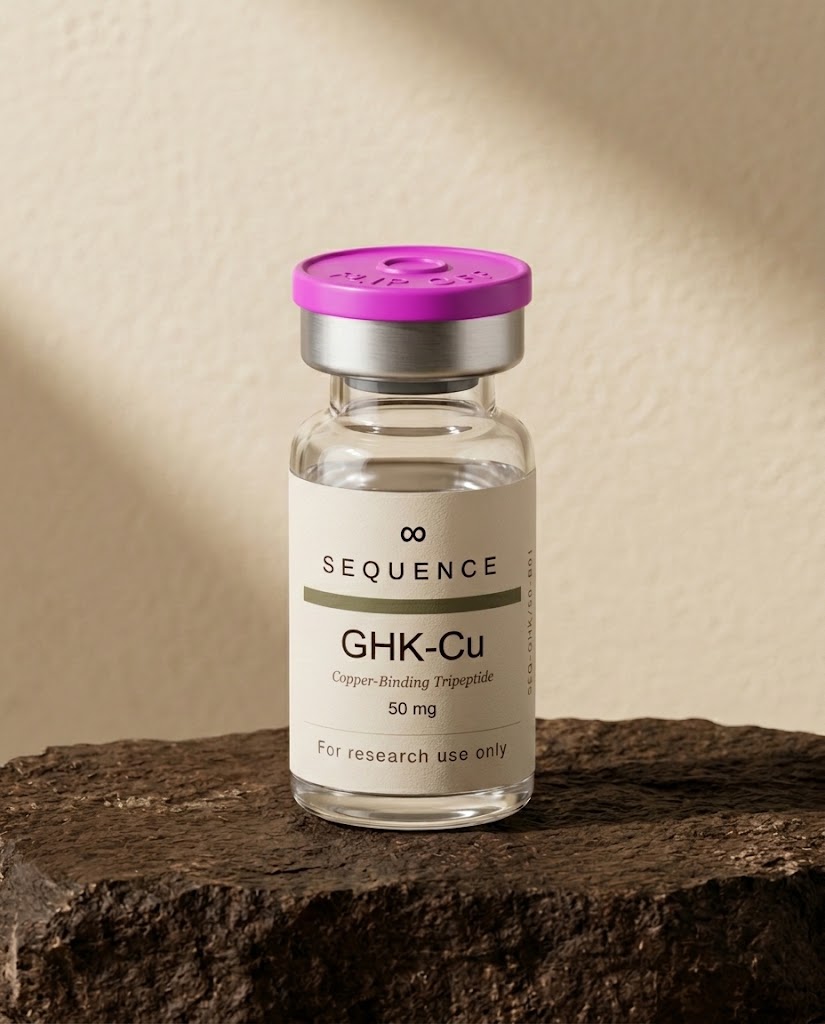
GHK-Cu 50MG
A naturally occurring copper-binding peptide - supports collagen synthesis, skin and hair renewal, and cellular repair.
45,00 €
50 mg vial
In stock
Per reference6units
Cadence5× per week
Dose1mg
Vial50mg / 3 mL
About
A copper-binding tripeptide naturally present in plasma, saliva, and urine — levels decline with age.
Research describes GHK-Cu as a regulator of gene expression favouring tissue repair and anti-inflammatory responses. It supports collagen and elastin synthesis, hair follicle activity, and angiogenesis. Clinical literature notes up-regulation of a broad subset of the human genome toward repair and homeostasis.
Sequence lists GHK-Cu under the Regenerate category - skin, hair, renewal.
Vial content
50 mg lyophilised GHK-Cu in a glass vial, reconstituted to the stated concentration for subcutaneous reference.
At reference, 6 units on a U-50 insulin syringe draws approximately 1 mg. Rotate between abdominal quadrants, outer thighs, and upper arms. The peptide is photo-sensitive - keep the vial shielded from direct light.
Storage: refrigerated 2–8°C after reconstitution. Do not freeze.
Reported effectsWhat the literature
What the literature
describes.
Accelerated wound healing
Skin tone, elasticity, texture
Reduced oxidative stress
Hair follicle activation
Reported timelineWhat the literature
What the literature
reports, by phase.
Week 1–2
01
Week 1–2 — Enhanced skin hydration, improved scalp circulation, calming of reactive skin.
Week 3–6
02
Week 3–6 — Texture and tone begin to even. Early fine-line softening. Reported reduction in oxidative markers.
Week 6–12
03
Week 6–12 — Collagen-dependent changes consolidate — firmness, scar modulation, follicle density.
Long-term
04
Long-term — Sustained skin resilience after cycling. Retention of density and tone through the off-phase.
Reference dosing
Reference profile.
Baseline
Standard6units / injection
1 mg · 5× per week (Monday–Friday)
- Injection siteSubcutaneous · abdomen, thigh, upper arm
- RotationQuadrant cycle, avoid repeat sites
- TimingAny time of day
Advanced
Agressive12units / injection
2 mg · 5× per week (Monday–Friday)
- Injection siteSubcutaneous · abdomen, thigh, upper arm
- RotationQuadrant cycle, avoid repeat sites
- TimingAny time of day
Recommended cycle
Three months on. One month off. Repeat up to three cycles annually.
Skin and follicle responses accumulate gradually — the gains registered during a cycle hold through the off-phase when collagen and elastin synthesis settle into the new baseline.
Vial details
| Content | GHK-Cu · lyophilised |
| Mass | 50 mg |
| Reconstitution | 3 mL water |
| Supply (baseline) | ~10 weeks |
| Light sensitivity | Shield from direct light |
| Storage | 2–8°C · do not freeze |
Mechanism
Copper bond. Gene signal.
GHK-Cu binds copper ions and shuttles them to tissue where it modulates gene expression toward repair. Fibroblast activity increases, collagen and elastin synthesis rises, and antioxidant pathways are enhanced.
Clinical literature describes up-regulation across a broad subset of the human genome — shifting cellular behaviour from inflammation toward regeneration.
- Copper bondDelivers copper ions to tissue as a co-factor for enzymes in collagen, elastin, and antioxidant pathways.
- Gene expressionShifts fibroblast and keratinocyte activity toward repair and renewal.
- Antioxidant defenceEnhances SOD and other antioxidant enzymes; reduces oxidative stress.
- AngiogenesisSupports capillary formation in healing tissue and scalp.
Safety signalsReported side effects
Reported side effects
& contraindications.
Reported side effects
- Injection-site redness or mild discomfort
- Rare copper sensitivity — rash, itching
- Occasional bruising or transient discomfort after injection
- Temporary fatigue (rare)
Contraindications
- Active malignancy
- Pregnancy or breastfeeding
- Known copper allergy or active skin conditions
- Known peptide or excipient hypersensitivity
Severe swelling, fever above 100.4°F, worsening fatigue, rash, dizziness, hives, breathing difficulty, or facial swelling — discontinue and contact a clinician.
Watch it done properly.
Reconstitution, site rotation, storage — on video.